


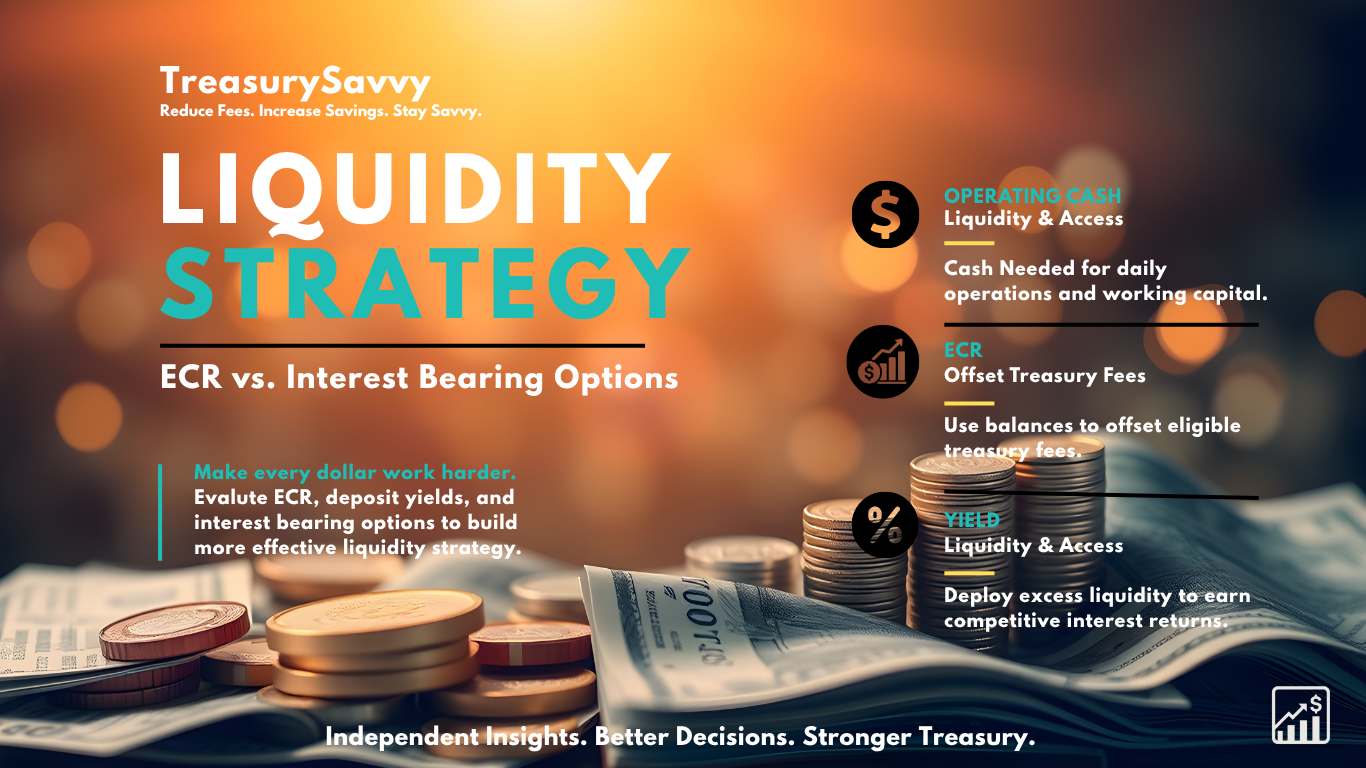
Is your excess liquidity working as efficiently as it could be? Learn how CFOs and treasury teams can evaluate ECR, deposit yields, treasury fees, and interest-bearing options as part of a broader liquidity strategy
For many organizations, liquidity management starts with a straightforward question:
Do we have enough cash available to operate the business?
But once that requirement is met, there is another important question CFOs and treasury teams should be asking:
Is our excess liquidity working as efficiently as it could be?
Companies can maintain significant balances within their banking relationships without periodically evaluating whether those balances are positioned appropriately. Some may be used to generate Earnings Credit Rate (ECR) credits to offset treasury fees. Other balances may sit in interest-bearing accounts or be swept into alternative investment vehicles.
There isn't one structure that's right for every organization.
The key is making sure the structure is intentional.
Start With the Purpose of the Cash
Before evaluating rates or investment options, treasury needs to understand what the cash is there to accomplish.
- How much liquidity is required for daily operations?
- What cash needs to remain immediately available?
- What reserves does the organization need?
- What cash is truly excess?
- What does the company's investment policy allow?
The answers will vary significantly depending on the organization, its capital structure, operating model, risk tolerance, and future plans.
Only after understanding those requirements should the conversation move to where the cash belongs.
Understanding Earnings Credit Rate
Many commercial banking relationships use an Earnings Credit Rate, or ECR, to generate credits on eligible operating balances that can be applied against qualifying treasury management fees.
For organizations with significant treasury activity, ECR can be an effective way to offset banking costs.
But there is an important distinction:
Earnings credits generally offset eligible bank fees. They are not the same as earning hard-dollar interest.
Once an organization is generating sufficient earnings credits to offset eligible fees, maintaining additional balances solely within that structure may not necessarily provide the greatest economic benefit.
That is where treasury teams should begin evaluating alternatives.
Should You Use Cash to Offset Fees or Earn Interest?
This is one of the conversations I believe more organizations should be having.
Historically, companies may have maintained balances to offset treasury fees through ECR and then moved remaining excess liquidity into interest-bearing solutions.
But there is another strategy worth evaluating:
What if you first negotiate your treasury fees to competitive market levels, pay the reduced fees directly, and position more of your available cash in appropriate yield-bearing vehicles?
Depending on the organization's balances, fee structure, ECR, available interest rates, liquidity requirements, and other considerations, that approach may produce a better overall economic outcome.
It isn't automatically the right answer. But it is a calculation worth making.
The decision shouldn't simply be:
ECR or interest?
The better question is:
What combination creates the greatest value for the organization while maintaining the liquidity and risk profile it needs?
Think About Liquidity in Layers
I like to think about corporate liquidity in layers.
Operating Cash
The first layer is the cash the organization needs to operate.
This is the liquidity required to support payroll, payments, working capital, and normal business activity.
Accessibility and certainty matter more here than simply maximizing yield.
Earnings Credit
The next consideration may be balances used to generate earnings credits against treasury management fees.
Treasury should understand the current ECR, the amount of balances required to offset eligible fees, and whether that remains an economically efficient use of those balances.
Interest-Bearing Liquidity
Once operating requirements are covered, organizations can evaluate appropriate interest-bearing deposit solutions for excess liquidity.
The objective is to earn a competitive return while maintaining the liquidity and risk parameters required by the organization.
Additional Investment Options
Depending on the company's investment policy, risk tolerance, liquidity requirements, and sophistication, treasury may also evaluate appropriate off-balance-sheet investment alternatives.
The specific structure will differ by organization.
What matters is that each layer has a purpose.
Every dollar of liquidity should have a job.
A Small Rate Difference Can Create a Significant Financial Impact
Liquidity optimization can sometimes create a larger financial opportunity than bank fee reduction.
Consider an organization maintaining $20 million in excess liquidity.
A 25-basis-point improvement in yield represents approximately $50,000 of additional annual interest income, assuming the balance remains consistent for the year.
A 50-basis-point improvement represents approximately $100,000 annually.
A 100-basis-point improvement represents approximately $200,000 annually.
The larger the liquidity position, the more meaningful relatively small differences in rates can become.
That's why CFOs shouldn't evaluate treasury fees and liquidity separately.
They are both components of the economics of the banking relationship.
Don't Assume Your Rate Is Competitive
Just as treasury service pricing can vary between organizations, deposit economics can vary as well.
Companies should understand:
- What rate are we currently receiving?
- How does it compare with available alternatives?
- When was it last reviewed?
- What balances are required to receive it?
- Are there liquidity restrictions?
- What is our current ECR?
- How much balance is required to offset our treasury fees?
- What is the economic value of those earnings credits?
- Could the cash be deployed more efficiently elsewhere?
Simply having an interest-bearing account doesn't necessarily mean the liquidity strategy is optimized.
Look at the Entire Banking Relationship
Liquidity shouldn't be evaluated independently from the rest of the banking relationship.
Treasury should understand the relationship collectively:
What are we paying?
What are we earning?
What balances are we providing?
What credit relationships do we maintain?
What other business does the bank receive from us?
That broader relationship can also create negotiating leverage.
A company providing significant deposits, treasury transaction volume, credit business, commercial card spend, or other revenue to its financial institution should understand the total value of that relationship when discussing pricing and rates.
The Highest Rate Isn't Always the Best Strategy
Liquidity optimization isn't about moving every available dollar to whichever institution quotes the highest rate.
Treasury has to consider safety, liquidity, operational requirements, concentration, counterparty exposure, investment policies, banking relationships, technology, and access to funds.
There may also be accounting and tax considerations that organizations should evaluate with their accounting and tax advisors.
The objective is not to chase yield.
It is to develop a liquidity structure that supports the business while maximizing appropriate financial value.
Questions CFOs Should Be Asking
CFOs don't need to manage daily cash positioning themselves.
But they should understand the strategy behind it.
Some questions worth asking include:
- How much operating liquidity do we actually need?
- Where is our excess cash today?
- What are we earning on it?
- Is that rate competitive?
- What is our current ECR?
- How much cash are we maintaining to offset bank fees?
- When did we last negotiate those fees?
- Would paying reduced hard-dollar fees allow us to deploy our liquidity more effectively?
- Does our current liquidity structure align with our investment policy and future capital needs?
Treasury should be able to provide a clear economic picture.
Liquidity Strategy Should Evolve
A liquidity strategy that made sense two years ago may not make sense today.
Interest rates change.
Bank pricing changes.
Cash balances change.
Companies acquire businesses, raise capital, pay down debt, expand internationally, and make investments.
Treasury should revisit its liquidity strategy as those conditions evolve.
The goal is not constant movement. The goal is intentional management.
The Bottom Line
Liquidity is one of the most valuable assets treasury manages.
The question isn't simply whether the company's cash is safe and accessible.
It's also:
Is that cash positioned as effectively as it could be?
For some organizations, ECR may continue to play an important role.
For others, there may be an opportunity to negotiate treasury fees lower and position more liquidity toward appropriate interest-bearing solutions.
Often, the right answer will be a combination.
At TreasurySavvy, we believe liquidity should be evaluated as part of the broader banking relationship, not in isolation.
Because ultimately:
The goal isn't simply to find the highest rate. It's to determine the most economically efficient place for each dollar of liquidity.
About TreasurySavvy
TreasurySavvy is an independent treasury advisory firm helping CFOs and treasury teams optimize banking relationships, liquidity, treasury pricing, commercial card programs, merchant costs, and overall treasury strategy.
We bring banking experience and independent market intelligence to the client's side of the table, helping organizations understand what they're paying, what they're earning, and where opportunities may exist to improve financial performance.
Is Your Liquidity Strategy Optimized?
If your organization hasn't recently evaluated its ECR, deposit yields, treasury fees, and overall liquidity structure together, TreasurySavvy can provide an independent assessment of where opportunities may exist.
Contact TreasurySavvy to learn more.


